 License:PA072883



Can I Repair a Flat Roof With a Vinyl Tarp?
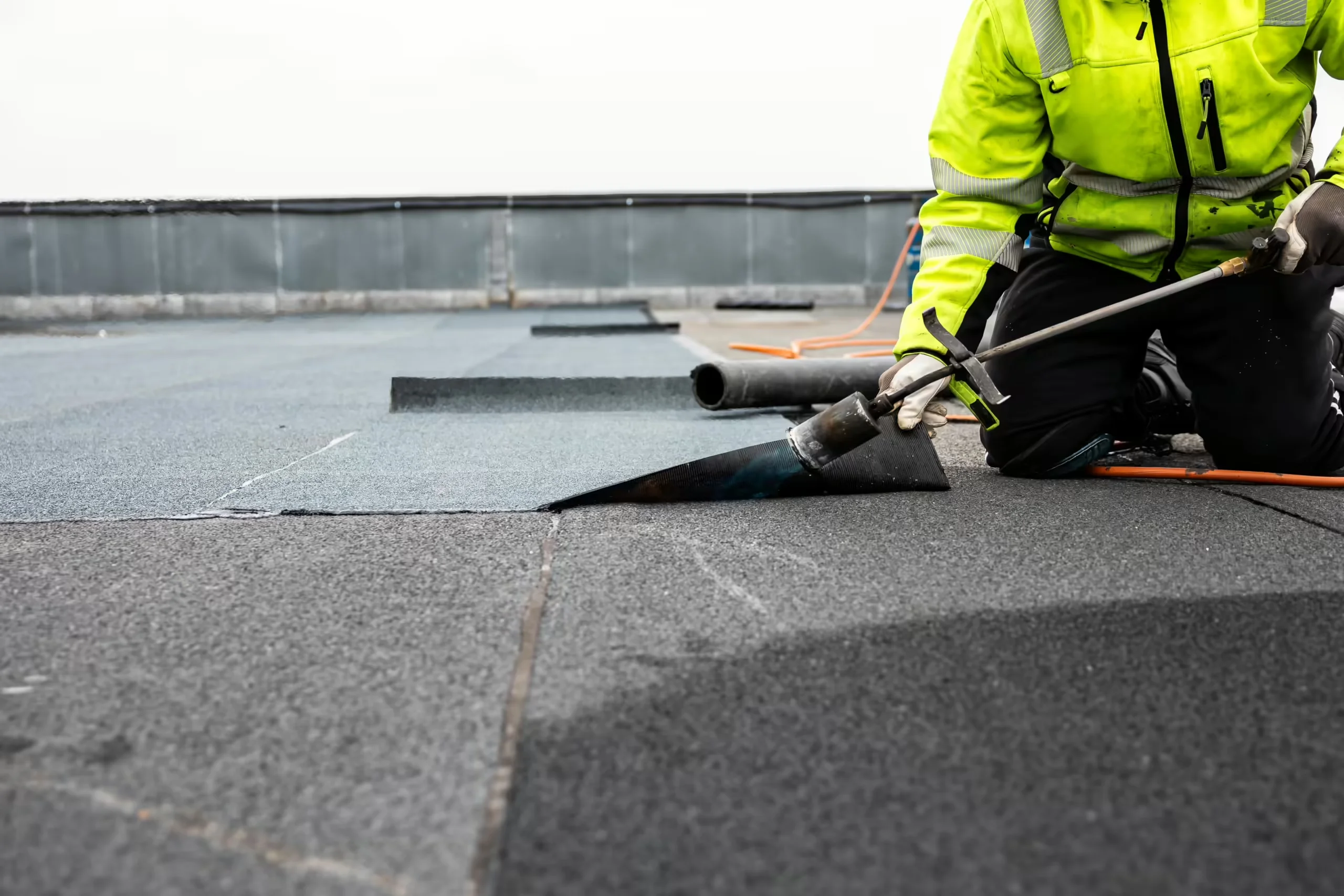
A storm rolls through overnight, and by morning there is a dark ring spreading across the ceiling of the back bedroom. The room below has a flat roof over it, maybe an addition or a porch cover or a section of a low-slope commercial building. You have a tarp in the garage. The question is whether that tarp can hold the line until a roofer can get out.
Yes, it can. Tarping is a legitimate emergency measure, and our crews install them on flat roofs regularly when a permanent repair has to wait a few days for materials, weather, or an insurance adjuster. But flat roofs are unforgiving about how a tarp goes on. A badly anchored tarp on a low-slope roof can leave you worse off than no tarp at all.
Here is what actually works, what fails, and where the line sits between a job a homeowner can handle and one that needs a crew.
The Short Answer: A Tarp Buys You Time, It Does Not Fix Anything
A tarp is a raincoat. It keeps water off a compromised surface while you sort out scheduling, budget, and paperwork. It does not seal a split seam, it does not dry out saturated insulation, and it does nothing about whatever caused the roof to fail in the first place.
Homeowners get into trouble when the tarp works well enough that the ceiling stops dripping and the problem stops feeling urgent. Meanwhile the decking under the membrane stays damp, and damp decking rots. What could have been a section repair in April becomes a full tear off by August. We see that sequence every year, and it is almost always avoidable.
Why Flat Roofs Are Harder to Tarp Than Pitched Roofs
On a pitched roof, gravity does half the work for you. Water runs downhill, a tarp lays flat against the slope, and the top edge tucks under a shingle course so wind cannot get a grip. A flat roof gives you none of that.
Wind Gets Underneath and Lifts
A tarp weighted only at the corners becomes a sail the first time a 40 mile per hour gust catches an edge. On a low-slope roof there is no slope to press the material down, so uplift pressure works on the whole sheet at once. Once one edge releases, the rest usually follows within minutes, and now you have a torn tarp, loose lumber on the roof, and an open hole in the middle of a storm.
Water Has Nowhere Obvious to Go
Flat roofs are not truly flat. They are built with a shallow pitch, usually a quarter inch per foot, that moves water toward drains or scuppers. Drop a tarp across that surface without thinking about drainage and you create a dam. Ponded water is heavy, roughly five pounds per square foot for every inch of depth, and a shallow puddle across a 20 by 20 section adds up fast on framing that is already compromised.
There Is No Course to Tuck Under
On a shingle roof you slide the top edge of the tarp under an intact course and the roof itself holds it down. A single-ply membrane, modified bitumen, or built-up roof has no equivalent. Every edge has to be mechanically held, which means boards, fasteners, and a real plan for the perimeter.
Is Vinyl Actually the Right Material?
Vinyl is an excellent exterior material in the right application. It is why vinyl siding and vinyl replacement windows hold up for decades on homes across our service area. A thin vinyl or polyethylene tarp off a big box shelf is a completely different product, and homeowners often assume the two are related.
For emergency roof protection, look at thickness and construction rather than the label on the package:
- 10 to 20 mil minimum. The standard blue tarp is around 5 mil and will chalk, stiffen, and split in a matter of weeks.
- Reinforced scrim. A woven grid laminated between layers is what stops a small puncture from running into a two foot tear.
- UV treated. Untreated poly loses most of its strength after a month of direct summer sun.
- Grommets every 18 to 24 inches. Corner-only grommets concentrate all the load in four spots, which is exactly where tarps fail.
- Oversized by three to four feet on every side of the damage. You need material to wrap around anchor boards, not just cover the hole.
Skip anything described as lightweight, economy, or general purpose. On a flat roof exposed to wind, thin material is not a budget version of the right tarp. It is a different outcome.
What You Need Before You Go Up
- Reinforced tarp, sized with generous overlap
- Two by four lumber cut to run the full length of each edge
- Exterior screws with washers, or cap nails
- Roofing cement or compatible seam tape rated for outdoor exposure
- Sandbags or pavers for supplemental weight, never as the only anchor
- A ladder with a standoff stabilizer and someone on the ground to foot it
One safety note that matters more on flat roofs than pitched ones: a wet membrane is genuinely slippery, and water-damaged decking can go soft without looking any different from the surface. If you cannot see where the damage extends, or the roof feels spongy under your weight, stop and call someone. No tarp is worth a fall through.
How to Tarp a Flat Roof the Right Way
1. Wait Until the Roof Is Safe to Walk
Do not go up during active wind, lightning, or ice. If the leak cannot wait for the weather to break, that is exactly the situation emergency crews exist for. Buckets and a plastic sheet inside the house will do more good in the middle of a storm than a rushed tarp job on a wet roof at night.
2. Clear the Surface and the Drains
Sweep off branches, leaves, granules, and standing grit. Then check every drain, scupper, and downspout connection, because a flat roof that cannot drain is a flat roof that ponds. If the gutters tied into the roof edge are packed with debris, clear those too. Half the ponding we find on flat roofs traces back to a blocked outlet rather than a failed membrane.
3. Lay It Out With Real Overlap
Center the tarp so it extends well past the damage on all four sides. If one sheet will not cover the area, overlap sections by at least 12 inches and run the overlap so the upper sheet sits on top of the lower one in the direction water travels. Seal the seam with outdoor-rated tape, then run a second strip over the first.
4. Anchor the Perimeter With Boards, Not Just Weight
This is the step that decides whether the tarp survives the week. Roll each edge of the tarp around a two by four so the lumber is wrapped in material, then fasten that assembly down along its full length. Continuous edge anchoring is what defeats wind uplift. Sandbags and pavers are useful as supplemental hold-down in the field of the tarp, but they are not a perimeter system on their own.
Be deliberate about where fasteners land. Every screw is a new hole in a roof that is already leaking. Fasten into solid framing at the perimeter where you can, keep penetrations outside the damaged zone, and seal each fastener head.
5. Keep the Water Moving
Before you walk away, look at the tarp the way water will. Are there dips where a puddle will form? Does the material run toward the drains or across them? Add a shim or a rolled towel under the tarp to break up a low spot if you need to. A tarp that sheds water lasts weeks. A tarp holding a birdbath fails in days and adds load to compromised framing the whole time.
6. Check It After Every Storm
Walk out and look after each significant wind or rain event. Loose fasteners, a lifted corner, a split at a grommet, or new ponding are all signs the tarp needs attention before the next system moves through. Take photos each time. If a claim is involved later, a dated record of the damage and your mitigation efforts is worth having.
What a Tarp Will Never Fix
Once the tarp is down, the clock starts. The next step is finding out what you are actually dealing with, which is why we start every flat roof call with a complimentary roof inspection and a written estimate. On low-slope roofs the entry point and the interior stain are frequently in different places, because water travels along the deck until it finds a seam or a fastener to drop through. Guessing usually means paying to fix the wrong three feet of roof.
Most of what we find is repairable. A failed seam, a cracked flashing detail at a wall termination, a punctured membrane, or a bad drain boot are all straightforward roof repairs that cost a fraction of a new roof. We say that plainly because our recommendation is repair-first by default. If your roof has years left in it, our job is to tell you that, not to sell you something bigger.
Sometimes the honest answer is that the system is done. Widespread blistering, saturated insulation across multiple bays, deck rot, or a membrane at the end of its service life all point toward a roof replacement. When we recommend one, we show you the photos and the moisture readings that led us there so you can see it for yourself.
How Long Can a Tarp Stay Up?
Two weeks is a reasonable working window for a properly installed, reinforced tarp. Thirty days is stretching it. Anything past a season and you are no longer protecting the roof, you are just hiding it. UV breaks the material down, fasteners work loose through freeze and thaw cycles, and trapped moisture underneath does quiet damage the entire time.
If cost is the reason a tarp has been up since last fall, that is worth a straight conversation rather than another winter of waiting. We offer financing with options that let homeowners handle a roof on a monthly basis instead of all at once, and knowing what a real repair costs usually changes the math on how long to leave a tarp in place.
Storm Damage Rarely Stops at the Roofline
The same wind or hail event that opened up a flat roof almost never limits itself to the roof. When we are up there for a tarp or a repair, we look at the whole exterior, because the parts that keep water out work as one system.
Siding and Trim
Wind-driven rain finds loose panels, cracked corners, and separated trim just as easily as it finds a membrane seam. Impact bruising on siding can be easy to miss from the ground and obvious from a ladder. For homes that have taken repeated hits, HardiePlank fiber cement siding holds up to impact and wind noticeably better than lighter materials, which is worth knowing before a repair turns into a repeat repair.
Windows and Doors
Storm pressure racks frames, breaks seals, and opens gaps at the perimeter that show up later as drafts, fogged glass, or water staining on interior sills. Some of that comes back with straightforward window repairs. When a unit is past saving, replacement windows with a proper window installation restore the seal correctly, which matters more than the window itself. The same goes for replacement doors, where a warped slab or a compromised threshold quietly lets water into the wall assembly.
The Insurance Side
Storm damage is one of the most common reasons homeowners in our area file a claim, and it is also where a lot of people leave money on the table by documenting only what they can see from the driveway. Our insurance restoration team documents the full scope with photos, measurements, and written findings, and we meet the adjuster on site so nothing gets missed in a walkthrough you were not part of.
When to Skip the Tarp and Call Right Away
Some situations are not homeowner projects, and recognizing that early saves both money and risk. Call for emergency home repairs rather than climbing up if any of these apply:
- The deck is sagging, spongy, or visibly deflected
- Water is actively running into living space or near electrical
- A large section of membrane is gone, not just punctured
- The roof is over a commercial space, a rental, or an occupied unit you are responsible for
- It is dark, icy, windy, or the roof is above the second floor
- You are not certain the damage stops where you can see it
We answer around the clock for storm response, and we get tarps installed on flat roofs the same day in most cases. A professional tarp uses continuous edge attachment, correct fastener placement, and materials sized for the exposure, and it will hold through weather that peels an improvised one right off.
Why Homeowners Trust RAM Roofing & Exteriors With Flat Roofs
- Complimentary roof inspections with a detailed written estimate, so you know what you are looking at before you spend anything
- Around-the-clock emergency storm damage response, including same-day tarping in most cases
- Repair-focused recommendations. If your roof can be repaired, we repair it. We do not sell replacements that are not needed
- Fully licensed and insured in Pennsylvania and New Jersey, PA072883 and NJ 13VH11020800
- A 4.9 star Google rating across more than 200 reviews from homeowners you can read for yourself
- Certified Owens Corning roofing installer, with installations backed by manufacturer standards and full warranty documentation at completion
Our office is in Doylestown, our crews are local, and you can learn more about our team and how we work before you ever pick up the phone.
Flat Roof Work Across Bucks and Montgomery County
Low-slope and flat roofs turn up everywhere in our region. They cover rear additions on older farmhouses, porch roofs on twins and row homes in the boroughs, dormer tie-ins, garages, and most of the small commercial buildings along our main streets. Wherever they are, they take the brunt of the same nor'easters, summer downbursts, and freeze and thaw cycles as everything else.
We see the most flat roof work in the older borough housing stock, so Bucks County towns like Quakertown and Newtown come up often, along with Montgomery County boroughs such as Lansdale and Conshohocken. Our crews cover a wider footprint than that across southeastern Pennsylvania and into New Jersey, and the full list is on our service areas page. If your town is not on it, call anyway. There is a good chance we are already working nearby.
Flat Roof Tarp Questions We Get Asked
Can I tarp a flat roof by myself?
For a small, accessible, single-story flat roof with clearly defined damage, yes, provided you have a reinforced tarp and can anchor the full perimeter with boards. If the roof is high, the damage is widespread, or the deck feels soft underfoot, it is not worth the risk. Call for emergency service instead.
Will a tarp make my insurance claim harder?
The opposite, usually. Most policies require the homeowner to take reasonable steps to prevent further damage after a covered loss. A tarp is exactly that. Photograph the damage before you cover it, keep receipts for materials, and keep dated photos of the tarp in place.
How much does professional flat roof tarping cost?
It depends on square footage, roof height, access, and how much of the perimeter needs to be secured. We give you a number before any work starts, and our inspection and written estimate are complimentary, so there is no cost to finding out what you are dealing with.
Can I tarp a flat roof in winter?
Yes, and we do it all winter. Cold weather makes tarp material stiff and harder to handle, adhesives cure slowly, and ice makes footing genuinely dangerous. Winter is the season where calling a crew rather than doing it yourself makes the most sense.
Why is water showing up in a different room than the roof damage?
On a flat roof, water that gets past the membrane travels sideways along the deck or through the insulation until it reaches a seam, a fastener, or a low point. It is common for the interior stain to sit ten or fifteen feet from the actual entry point, which is why a proper inspection beats patching the spot directly above the drip.
Should I just replace the whole flat roof instead of repairing it?
Not automatically. If the membrane is otherwise sound and the damage is localized, a repair is the right call and it is what we will recommend. Replacement makes sense when the roof is at the end of its service life, the insulation is saturated, or repairs have become an annual event. More answers to common questions are on our FAQ page.
Schedule Service or Call (215) 315-7700
If your flat roof is leaking, tarped, or you are not sure how bad it is, we will come look at it and tell you the truth about what it needs. Inspections come with a detailed written estimate at no cost, and we answer the phone around the clock for storm emergencies.
Call or text (215) 315-7700, or reach out through RAM Roofing & Exteriors online. Our office is at 52 E Oakland Ave Ste 3A, Doylestown, PA 18901.